
ISTANBUL: Malaysia has proposed reviving the International Zakat Organisation (IZO) to coordinate global zakat collection and distribution, particularly to support poorer Muslim countries and minority communities.
Deputy Prime Minister Datuk Seri Dr Ahmad Zahid Hamidi said he raised the proposal with Turkish President Recep Tayyip Erdogan, D-8 Secretary-General Sohail Mahmood and several other leaders.
He hoped the proposal would be tabled at formal and informal meetings of the Organisation of Islamic Cooperation (OIC) and Developing Eight (D-8).
The idea was first mooted by the late Saudi Arabian businessman Sheikh Saleh Kamel during the administration of Malaysia’s fifth Prime Minister, Tun Abdullah Ahmad Badawi.
“At the time, I was appointed chairman of the World Zakat Organisation while serving as religious affairs minister.
“The aim was to collect zakat funds from wealthy Muslim countries, including funds generated from petrodollars deposited in commercial banks and other financial institutions.
“This was because they did not take the interest earned from their bank savings or deposits, as it was considered riba,” he told reporters at an exit press conference marking the end of his working visit to Turkiye.
Zahid said discussions could be held on channeling such interest earnings into the IZO to support poorer Muslim countries and communities where Muslims were minorities.
He said the funds could then be distributed among the eight categories of eligible zakat recipients (asnaf) to improve the socioeconomic well-being of Muslims worldwide.
Meanwhile, Zahid said Malaysia also discussed strengthening cooperation with Turkiye in the global halal industry.
He said Malaysia, which had been involved in halal certification for 52 years, had discussed the potential for halal products to tap into the growing global market.
Turkiye was also a significant producer of halal products, not only in food and beverages but also in medicine, cosmetics, vaccines and other manufacturing materials, he added.
“By 2030, the global halal market is expected to be worth about US$1.3 trillion.
“We must seize this opportunity to forge cooperation between Malaysia, Turkiye and other Muslim countries to jointly advance this proposal at the global level,” he said.
Zahid concluded his four-day working visit to Turkiye today, with engagements focused on strengthening Malaysia-Türkiye ties through diplomatic, trade, defence and education cooperation.
During the Nov 5-8 visit, he attended the 2026 TRT World Forum at the Istanbul Congress Centre on Nov 6, which brought together political leaders, policymakers and academics to discuss geopolitical challenges.
He also held talks with Erdogan on regional security, including the conflicts in Gaza, Syria and Lebanon, as well as ways to strengthen bilateral ties.
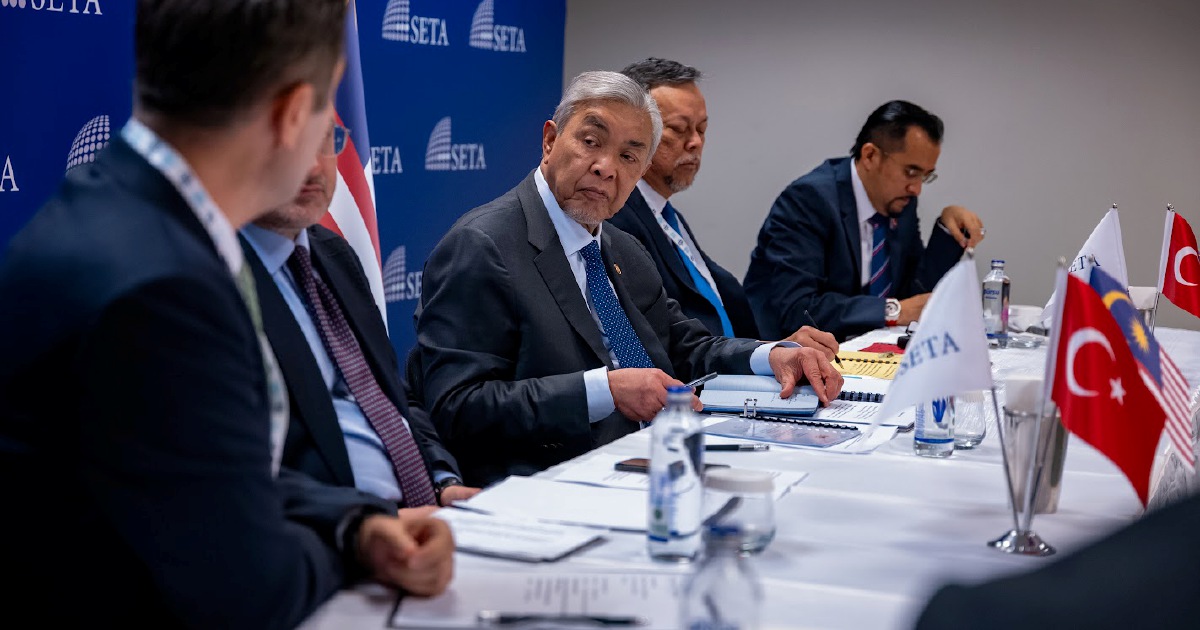
Zahid also took part in a roundtable with the Foundation for Political, Economic and Social Research (Seta), which discussed the need for international action against Israel.
On defence and the economy, discussions covered technology transfer, defence industry development and a proposal to establish a ship maintenance, repair and overhaul hub in Bagan Datuk.
Both countries also explored increasing bilateral trade from US$5.6 billion to US$10billion by 2030.
In education, Mara institutions signed Letters of Collaboration (LOCs) with Sabanci University and Yildiz Technical University.