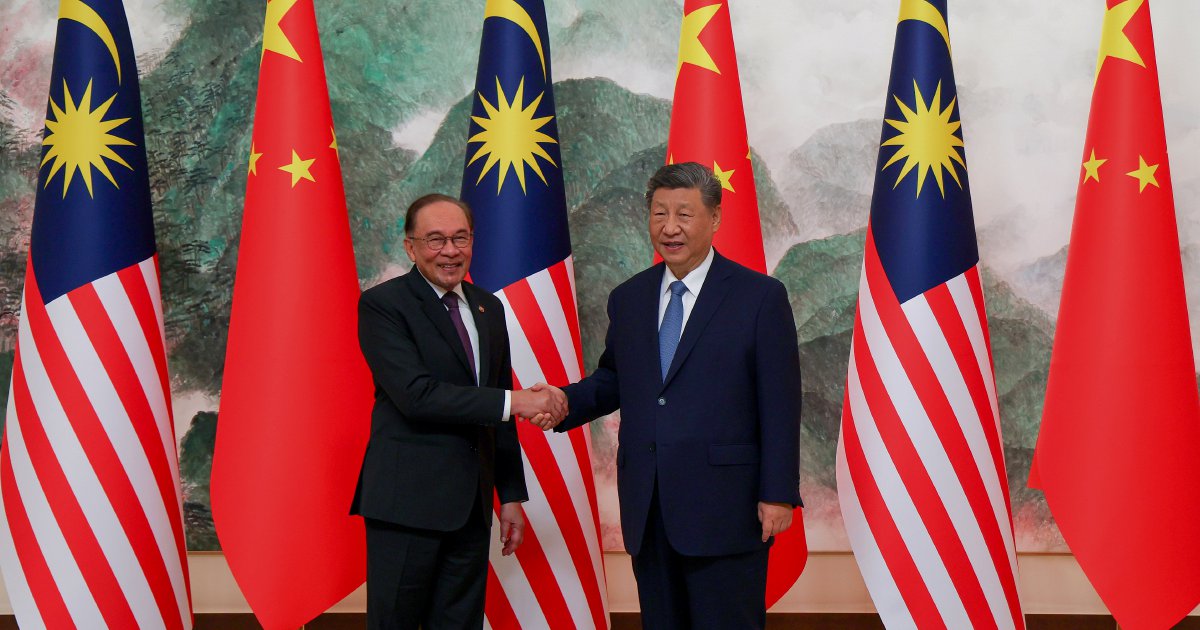

SHENZHEN: Prime Minister Datuk Seri Anwar Ibrahim held a bilateral meeting with Chinese President Xi Jinping at the Qilin Villa state guest house here today.
The meeting, which began at 12.15pm, lasted 25 minutes, with both leaders discussing economic and geopolitical ties between the two countries, which have enjoyed 52 years of diplomatic relations.
This was Anwar’s fourth bilateral meeting with Xi since becoming prime minister in 2022. The first was held in Beijing on Nov 7, 2024, followed by another in Putrajaya on April 16 and a third in the Chinese capital on Sept 2 last year.
Anwar said Malaysia was looking to elevate its diplomatic relations with China by expanding high-level ministerial cooperation to include the two countries’ respective defence and home ministries under an arrangement known as “3+3”.
“Our relationship with China has reached a rather optimal level, coordinated by the Foreign Ministry and the ambassador here, but now we want to elevate it further.
“So there is a cooperation mechanism that rarely happens. I think perhaps only two or three countries have such an arrangement, involving periodic meetings between three ministers simultaneously: the Foreign Ministry, the Defence Ministry and the Home Ministry,” Anwar told Malaysian media after the meeting.
Anwar also commended Xi for his efforts to bring together United States President Donald Trump and Russian President Vladimir Putin for a trilateral meeting in Shenzhen. He said the meeting was important as it would help guarantee peace in the region and benefit Malaysia.
“Our focus is not just on peace but also on trade and investment. For example, our relationship with Russia in terms of oil imports and so on. When there is that resolution, it facilitates and brings relief,” Anwar said.
During the meeting, both sides reiterated their commitment to strengthening regional cooperation and collaboration, as well as increasing investments.
Anwar called for the acceleration of bilateral investment projects in critical infrastructure, including the Northern Perak water supply and transfer programme, which will benefit the entire state of Penang and northern Perak, as well as an artificial intelligence-powered border control system.
Anwar also said China would send senior delegations to attend the launch of the East Coast Rail Link in December.
Both countries also discussed cooperation in technical and vocational education and training (TVET), as well as university research.
Malaysia is also open to working with all countries, including China, to develop its rare earth industry, subject to regulations and the condition that there would be no export of raw materials.
Anwar said Xi had emphasised the importance of cooperation and further discussions, research and understanding of Islam and Confucianism, as well as the Malaysia Madani concept.
“So I certainly gave an assurance that we will provide our full cooperation with universities through several measures, because it rarely happens that a country with a large non-Muslim majority makes the decision to respect our views and agrees to continue cooperation in studying, honouring and enhancing the understanding of Islamic civilisation and culture,” he said.
Anwar was accompanied by Investment, Trade and Industry Minister Datuk Seri Johari Abdul Ghani, Home Minister Datuk Seri Saifuddin Nasution Ismail, Foreign Ministry secretary-general Tan Sri Amran Mohd Zin, National Security Council director-general Raja Datuk Nushirwan Zainal Abidin, Malaysia’s Ambassador to China Datuk Norman Muhamad, Malaysian Investment Development Authority chairman Tengku Datuk Seri Zafrul Aziz and other senior government officials.
The Chinese delegation included Xi, Foreign Minister Wang Yi, Guangdong Provincial Committee of the Chinese Communist Party secretary Huang Kunming, Public Security Minister Wang Xiaohong, Finance Minister Lan Fo’an, China’s Ambassador to Malaysia Yao Wen and other senior government officials.
The bilateral meeting concluded Anwar’s three-day official visit to China for the 33rd Apec Economic Leaders’ Meeting in Shenzhen. It was also his sixth visit to the country as prime minister.
The visit reaffirmed the strong relations between Kuala Lumpur and Beijing, with discussions covering economic, geopolitical and regional cooperation.
In his speeches during the visit, Anwar reiterated Malaysia’s commitment to maintaining its centrality in regional geopolitics amid a fragmented global landscape, while supporting rules-based multilateral arrangements and cooperation.
Xi used the Apec meeting as a platform to push for greater regional integration among Asia-Pacific economies, calling for the establishment of an Asia-Pacific Free Trade Area based on the principles of fairness and equality among nations.
Asia-Pacific countries are Malaysia’s largest trading partners, accounting for almost 80 per cent of the country’s total trade, with China having remained its largest trading partner for 17 consecutive years. Trade between Malaysia and China is valued at more than RM500 billion.
Meanwhile, the United States remains an important trading partner and source of foreign investment, with investments totalling RM33.1 billion in the first half of 2026.
Established in 1989, Apec is the world’s largest regional economic forum in terms of geographical area, gross domestic product and population. It focuses on trade facilitation, regulatory alignment and economic and technical cooperation across the Pacific Rim.
Asia-Pacific economies have also entered into various regional cooperation agreements and partnerships, including the Regional Comprehensive Economic Partnership, the Comprehensive and Progressive Agreement for Trans-Pacific Partnership and the East Asia Summit.