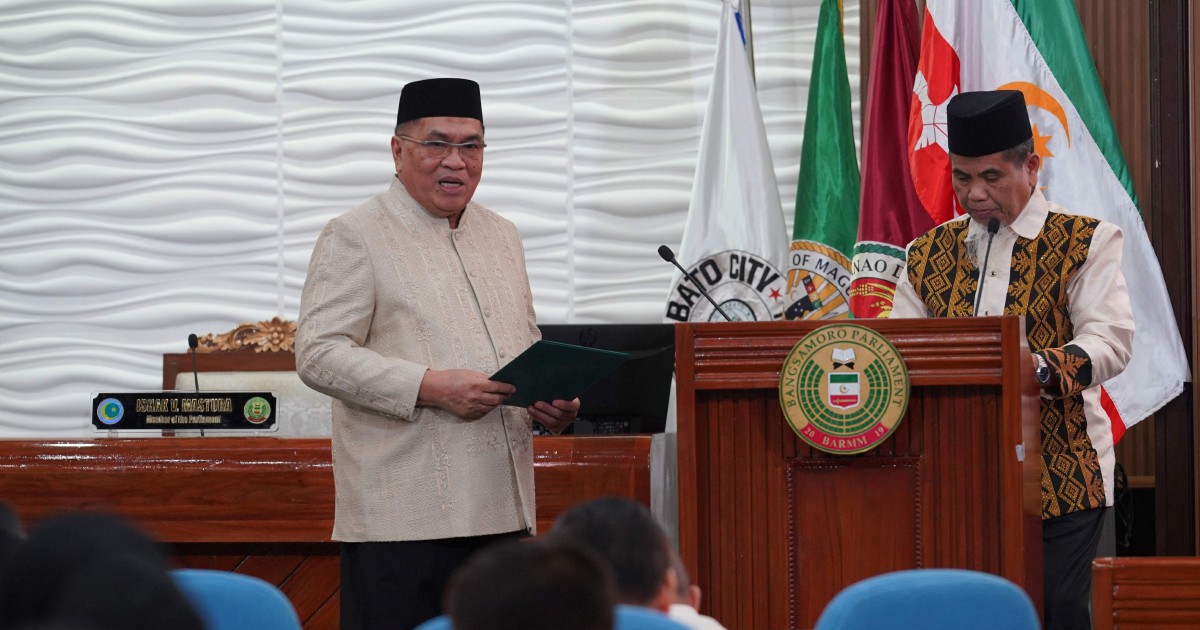

ABDULRAOF Macacua, the former head of the Bangsamoro Islamic Armed Forces, the armed wing of the Moro Islamic Liberation Front (MILF), was elected on Oct 30 as the first chief minister of the Bangsamoro Autonomous Region in Muslim Mindanao (BARMM) when the BARMM Parliament convened following the Sept 14 election.
Macacua, who served about a year as interim chief minister before the parliamentary election, was a shoo-in, gaining 51 parliamentary votes in the 80-member legislature.
His only rival for the post, Al Haj Murad Ebrahim, who preceded Macacua as interim chief minister, managed only 27 votes.
The election produced a hung parliament, with the Bangsamoro Federalist Party (BFP) headed by Macacua securing 31 legislators against 30 for the United Bangsamoro Justice Party (UBJP), which is the political offshoot of the MILF.
Philippine President Ferdinand Marcos Junior did not sit idly by but swung into action following the election, convening a meeting at the presidential palace in Manila which evidently was instrumental in corralling an initial 46 legislators to give the BFP a governing majority.
The first order of business when the BARMM Parliament convened on Oct 30 was not the election of the chief minister. Instead, it was an address in person by the president, no less. As Rufa Cagoco-Guiam, a columnist writing in the Philippine Daily Inquirer on Nove 3, pointed out:
“Given presidential support, including pecuniary and political leverage and future access to both regional development funds and a regional version of the national pork barrel, the BFP held an ace over the UBJP in their respective efforts toward creating a coalition of the region’s political parties.”
Perhaps it is realpolitik pure and simple for both the national government in Manila and the supposedly autonomous BARMM government in Cotabato City to be seen as closely aligned politically. Too bad if it meant MILF, which sealed the pact with the Philippine government in 2014 leading to the creation of BARMM, is now politically split in two.
With the political track in the autonomy journey more or less settled, will the elected BARMM regional government and the one led by the former head of the MILF armed wing bring urgency to settling the equally important military track, the normalisation by disarmament of the former MILF armed insurgents?
If new focus and energy can be brought to settling the military track – a task which the interim BARMM government signally failed for a dozen years – any scepticism about a BFP-led elected government may well dissipate eventually.
As Cagoco-Guiam cogently asked: “Was it worth creating an asymmetrical form of government to rectify national historical injustices against the Bangsamoro?
“Will the impoverished and marginalised sectors in the region finally feel the difference between a regular parliamentary government and what they had in the past?”
The first elected BARMM government thankfully has a good five years to prove its worth.
Unless the thorniest issues get settled before the government finishes its term in 2031, succeeding governments with shorter three-year mandates may struggle to make much of a difference, with political autonomy or without.
- The writer views developments in the nation, region and the wider world from his vantage point in Kuching