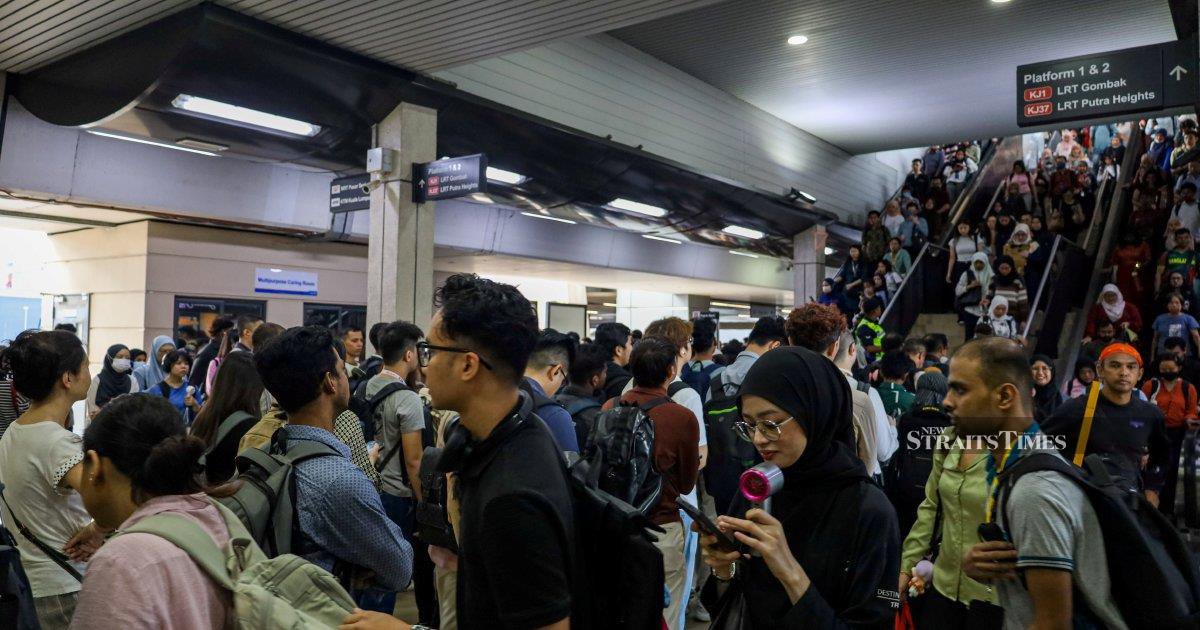

KUALA LUMPUR: Frequent disruptions on the Kelana Jaya LRT Line could affect workers’ punctuality and productivity while adding operational and financial burdens on employers, employer groups said.
Malaysian Employers Federation (MEF) senior adviser for government, media and international engagement Datuk Syed Hussain Syed Husman said unreliable train services could disrupt daily business operations.
He said the impact could be particularly significant in manufacturing, retail, hospitality, healthcare and customer service, where employees’ physical presence is essential.
“When employees arrive late, employers will face difficulties arranging shift handovers, maintaining adequate staffing levels, serving customers on time and meeting operational deadlines.
“Other employees may have to take on additional responsibilities, increasing their workload and affecting overall efficiency,” he said.
He added that repeated disruptions could also cause stress and fatigue among commuters, particularly those forced to make alternative travel arrangements at short notice.
On workplace policies, Syed Hussain said some employers offered flexibility such as replacement working hours and work-from-home options, but these were not practical across all industries.
He urged employers to assess genuine public transport disruptions fairly on a case-by-case basis, while employees should inform supervisors as early as possible and make reasonable efforts to minimise the impact on their work.
“Genuine transport disruptions should not be treated as misconduct. Reliable public transport is essential not only for workers’ welfare but also for business productivity and Malaysia’s economic competitiveness,” he said.
Malaysian Trades Union Congress (MTUC) president Datuk Abdul Halim Mansor said employees should not face disciplinary action or lose employment benefits because of Kelana Jaya LRT disruptions beyond their control.
“Employees will be affected not only in terms of productivity and business operations, but also in areas such as personal records, performance evaluations, incentive payments, annual increments and bonuses.
“Another question is whether the losses should be borne by employees or the train operator, given that the disruptions are beyond the employees’ control,” he said.
Halim called on Prasarana Malaysia Bhd to consider compensating affected employees and companies for losses arising from the disruptions.
“Employers should not take action against employees for delays that are beyond their control.
“As this is a public issue, the Transport Ministry and Human Resources Ministry must work together to address the matter collectively and amicably,” he said.
Meanwhile, Small and Medium Enterprises Association Malaysia (Samenta) president Datuk William Ng said recurring disruptions on the Kelana Jaya LRT Line should be treated as an economic issue rather than merely an inconvenience.
He said they could affect business operations and delivery schedules.
“For example, mall operators impose fines on retailers if stores are not opened on time. Customers could also be waiting for important parcels if employees arrive late.
“For most businesses, the impact is minimal if it is a rare occurrence. However, for retail, food and beverage and logistics businesses, the impact could be substantial,” he said.
Ng urged Prasarana and the government to provide real-time service alerts, deploy feeder buses promptly and issue electronic delay certificates for affected commuters to submit to their human resources departments or supervisors.
He also called for more rigorous preventive maintenance and greater accountability to address recurring technical failures.
“The Kelana Jaya Line is the commercial lifeline of the Klang Valley, and businesses cannot continue to pay the price for recurring operational failures,” he said.
Checks by the New Straits Times found more than 45 official announcements by Rapid KL on its Facebook page from January to Oct 10 this year.
July recorded the highest number, with seven announcements, while 11 service delays were reported over the period.
Other issues included train and platform door malfunctions, track switch system outages and power supply disruptions.